All work
Oracle NetSuiteJapan TegataDensaiLocalisation

Japan Promissory Notes: designing for Tegata and Densai

Tegata is a Japanese promissory note, a paper-based payment instrument with no direct equivalent outside Japan. Densai is its electronic successor. Designing for both inside a global ERP platform meant rethinking the model almost from scratch, for users whose mental model was completely unlike anything in the existing product.

At a glance

Problem
Japanese finance teams tracked Tegata and Densai in spreadsheets alongside NetSuite, risking missed maturity dates.
My role
Led Tokyo research with AR and AP teams, then designed the instrument model, lifecycle UX, and localisation.
Key decision
Let each instrument’s status determine available actions, while supporting partial Densai use within a shared model.
Result
The Tegata and Densai lifecycle shipped natively for Japan, replacing external spreadsheet tracking. The component was designed for reuse in future markets.
Company
Oracle NetSuite
Role
Experience Design Lead, JAPAC
Market
Japan only
Research
Face-to-face, Tokyo
My contribution
Product model, lifecycle UX & localisation
Delivery
Native Japan release; shared component designed for future markets

What Tegata is, and why it needed its own model

A Tegata is a promissory note: a written promise to pay a specified amount on a future date, typically 90 to 120 days out. Japanese companies use Tegata both to pay vendors (payable Tegata) and to receive payment from customers (receivable Tegata). Before the maturity date, businesses often discount receivable Tegata at their banks to receive cash early, or endorse them to a third party as payment to a vendor.

Densai is the electronic equivalent, managed through the densai.net registry established by the Japanese Bankers Association. Unlike paper Tegata, Densai can be split and partially assigned. A business might receive a 1,000,000 JPY Densai and discount 300,000 JPY of it while endorsing the remaining 700,000 JPY to a supplier. This partial splitting capability is unique to Densai and has no equivalent in traditional accounting software.

A Tegata is a dated payment instrument. Its issuer, receiver, amount, bank, and maturity date shape the user’s mental model.

Why this was hard to design
The existing NetSuite Tegata feature was Japan-only and had been built by the core engineering team without user research. The new feature needed to extend support to Densai, accommodate the partial-use model, and eventually become a shared component available to other markets with similar instruments. Every design decision had to work now for Japanese users and scale later for an international architecture.
How might we
enable Japanese NetSuite users to manage the full lifecycle of Tegata and Densai (issuance, endorsement, discounting, partial use, and settlement) within NetSuite, with correct GL impact at each stage, while building a foundation that can extend to other markets with similar payment instruments?

Learning the workflow from AR and AP teams in Tokyo

I interviewed Japanese finance and accounting professionals in Tokyo who were managing Tegata and Densai outside NetSuite: in spreadsheets, bank portals, or separate accounting tools. Their mental model was different from standard accounts receivable. They thought in instruments with statuses, not transactions with amounts, and the maturity date mattered as much as the amount.

Densai added a problem no NetSuite pattern handled: users needed to see how much of each instrument had already been used for discounting or endorsement, and how much remained.

The AR Clerk
Accounts receivable // Japan SME
The AP Clerk
Accounts payable // Japan SME
The Finance Manager
Treasury and cash management // Japan
Context
Receives Tegata from customers instead of cash, records them in NetSuite, and manages their lifecycle to maturity.
Issues Tegata to vendors as payment, and may endorse received Tegata to pay other vendors.
Plans cash flow and needs visibility of when Tegata and Densai will mature and convert to cash.
Primary task
Apply receivables to open invoices, track maturity, and initiate collection or discounting.
Issue payable Tegata with the correct maturity date, track obligations, and record clearance.
See outstanding instruments, maturity dates, and available Densai balances for discounting decisions.
Pain point
The feature reflects NetSuite’s transaction model, not the Tegata mental model; maturity tracking is manual.
No unified view of payable Tegata and maturity dates; spreadsheets sit alongside NetSuite.
Needs a clear view across instruments to make confident cash-flow decisions.
Densai-specific need
—
—
Track each instrument’s remaining balance after partial discounting or endorsement.
Bilingual interview guide: structured customer research in Tokyo, Japanese and English

Bilingual interview guide: structured customer research in Tokyo, Japanese and English

Bilingual interview guide: structured customer research in Tokyo, Japanese and English.

From status tracking in spreadsheets to a native NetSuite workflow

Current stateTarget state
01

Maturity dates tracked in spreadsheets alongside NetSuite, with a high risk of missed collection or payment.

01

Tegata and Densai lifecycle managed entirely within NetSuite from receipt to collection or payment.

02

Tegata status is not visible in a single view and requires navigating multiple transaction screens.

02

Status-based view of outstanding instruments, with maturity dates and available Densai balance visible.

03

Partial Densai use is not supported, so users manage split amounts in external tools.

03

Partial Densai discounting and endorsement supported, with remaining balance calculated automatically.

04

No alert or notification when a Tegata approaches its maturity date.

04

Maturity dates are visible in the status-based view, so finance teams can act before collection or payment is missed.

05

Discounting and endorsing operations require manual journal entries, increasing the risk of error.

05

GL impact generated automatically at each status transition, removing manual journal entries.

Tegata and Densai lifecycle: full status model from receipt to settlement

Tegata and Densai lifecycle: full status model from receipt to settlement

01
Domain immersion
Studied Tegata and Densai thoroughly before designing anything, including the densai.net documentation and regulatory materials to understand the full transaction lifecycle.
02
Customer research
Face-to-face interviews in Tokyo with AR clerks, AP clerks, and finance managers. Focused on mental models and current workarounds, not feature requests.
03
Status model design
Designed the status lifecycle as the primary UX model (instruments with states and context-driven actions) rather than static transaction forms.
04
Partial-use pattern
Designed the new model for Densai partial use: available-balance tracking, partial discount and endorsement flows, and GL impact at each step.
05
Shared component design
Architected the feature as a shared component from the start, abstracting Japan-specific elements so the core model could support other markets' similar instruments.

Designing for instruments, not transactions

The design followed that mental model, and it became the central decision of the project.

Decision I made
Model each Tegata as an instrument with a status, not as a transaction. The status decides which actions are available, so users can only collect, discount, or endorse when that action is valid. It meant departing from how NetSuite normally handles financial transactions, but it matched how finance teams in Tokyo actually think about their work.

Tegata and Densai lifecycle: the shared instrument model, with Densai partial allocation made visible.
Receivable Tegata
Status
What it means
Available actions
Holding
Received and awaiting a finance decision.
CollectDiscountEndorse
Discounted
The bank has advanced cash before maturity, less its fee.
View GLNo further action
Endorsed
Transferred to a third party as payment to a vendor.
View GLNo further action
Collected
Maturity has been reached and funds are deposited to the bank account.
View GLClosed
Payable Tegata
Status
What it means
Available actions
Issued
Issued to a vendor; the payment obligation remains outstanding.
Mark as paidWhen cleared
Endorsed
Created by endorsing a receivable Tegata to a vendor; the obligation remains outstanding.
Mark as paidWhen cleared
Paid
The bank has confirmed payment and the obligation is settled.
View GLClosed
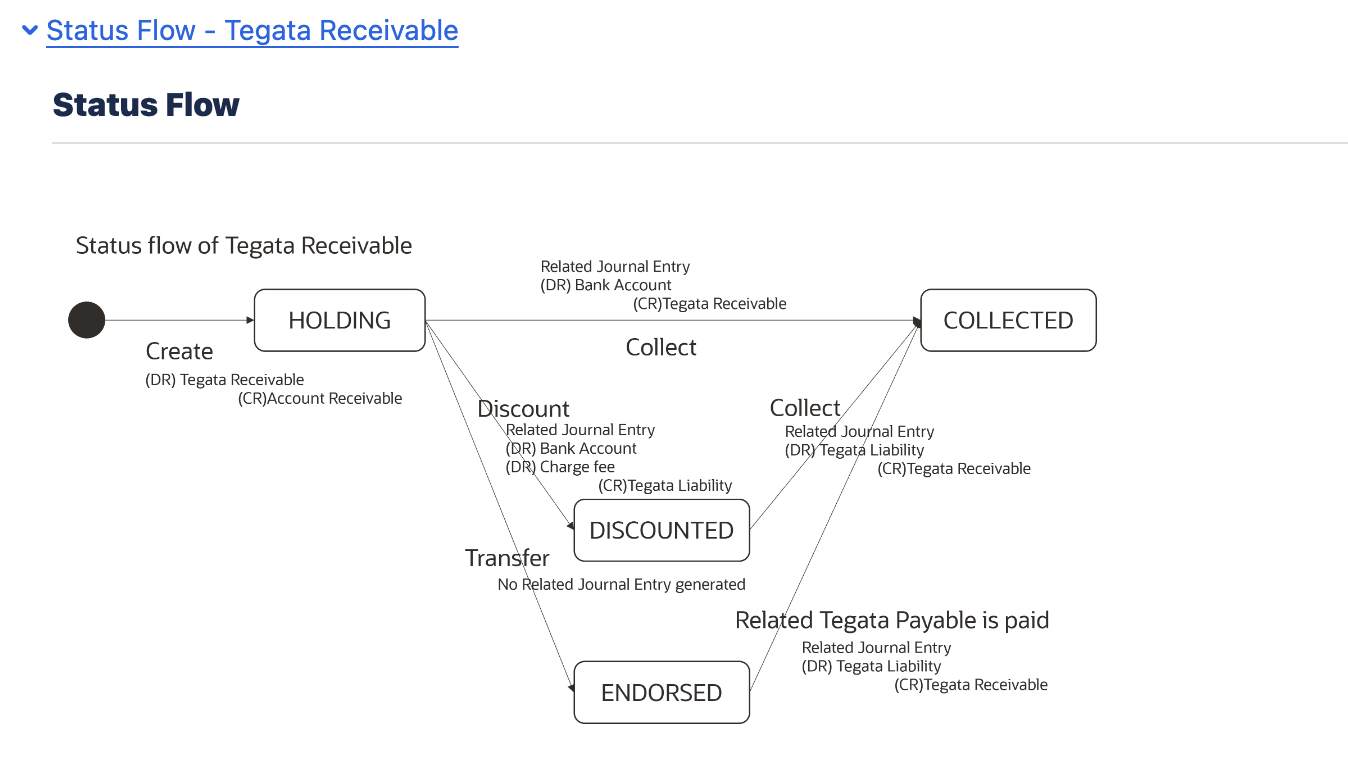
Tegata receivable status flow from holding to collection, discounting, or endorsement Status flow diagram: all states, transitions, and GL impact

Status flow diagram: all states, transitions, and GL impact

Densai partial use: available balance tracking after split discounting and endorsement

Densai partial use: available balance tracking after split discounting and endorsement

Receivable Tegata begins in Holding. From there, finance teams can collect at maturity, discount for early cash, or endorse the instrument to a vendor.
Payable Tegata can be created directly for a vendor or by endorsing a receivable. Both remain visible until payment is confirmed.

For Densai, the interface also had to show the remaining balance after partial discounting or endorsement, which needed a new data model and UI pattern.

Tegata and Densai shipped to Japan market
Partial Densai use supported natively
Shared component architecture for future markets
External spreadsheet dependency eliminated
What I took from this
When a domain has no equivalent elsewhere, the fastest route to a good design is learning the domain properly before designing anything.

Future opportunities, informed by the research

The product outcomes above were shipped. The following concepts are future opportunities, informed by the research but not presented as delivered functionality.

Opportunity
AI-enabled Tegata dashboard with maturity prioritisation

Research showed finance managers’ biggest risk was missing a collection date, not the mechanics of collecting. An AI-enabled dashboard could rank instruments by urgency, flagging approaching maturities and closing Densai discount windows, so it tells users what to do today.

Maturity alerts // Prioritised action view // Densai discounting window tracking // Missed collection risk reduction
Opportunity
AI-assisted Densai partial-use optimisation

Choosing which Densai to discount, and by how much, is currently a manual judgement call. With visibility of cash position, payables, and maturities, AI could suggest a partial-use strategy, such as discounting ¥300,000 now and collecting the rest at maturity.

Optimal discounting recommendations // Cash timing optimisation // Reduces manual financial modelling
Opportunity
Counterparty risk signals from Tegata patterns

Extension requests, late endorsements, and partial payments can be early signs of a customer in financial stress. AI could surface these signals to finance managers before they become bad debt, turning Tegata management into an early credit-risk check.

Early counterparty risk detection // Extension pattern monitoring // Credit risk signal surfacing