K-Bot: AI chatbot for IFRS query automation
Auditors are trained to be sceptical. It's their job. So when KPMG asked me to design an AI assistant for audit work, the hardest design problem wasn't the conversation flows or the NLP model. It was designing a tool that a profession grounded in scepticism would choose to use.
At a glance
IFRS is complex. Finding answers shouldn't be.
International Financial Reporting Standards (IFRS) are a set of accounting standards developed by the International Accounting Standards Board (IASB). Applying IFRS isn't simply a matter of converting old accounts into new international formats. It is complex, constantly evolving, and challenging for any accounting professional who lacks deep IFRS expertise.
KPMG auditors and associates spent significant time manually searching for relevant standards, cross-referencing source materials, and escalating queries to senior staff. The workload was high, the process was slow, and the risk of misapplication was real.
Pain points from the accounting profession
We interviewed auditors and associates to understand how they currently worked with IFRS standards and where the process broke down.
Three perspectives, three distinct needs
The Auditor
Senior accounting professional
The Associate
Early-career accounting professional
The KPMG Client
Business owner or finance lead

User journeys: Auditor and Associate paths through K-Bot
From manual searching to cited answers
Auditors search manually across multiple document repositories and source materials to locate relevant IFRS standards.
Auditors query relevant standards in natural language and receive sourced responses at the moment of need.
Associates escalate routine queries to senior staff, creating bottlenecks and slowing client response.
Associates access simplified explanations and examples independently, reducing unnecessary escalation.
No centralised mechanism surfaces simplified explanations or illustrative examples at the point of need.
Plain-language explanations and examples are available alongside the relevant standard.
New or updated IFRS standards are difficult to track, increasing the risk of misapplication.
Current source material and citations give users a visible basis for checking the response.
Client response times are slower than they should be, and quality depends on individual knowledge rather than shared capability.
Response quality is more consistent across the team, with escalation reserved for the right cases.

From audit workflow to conversational design
A conversational AI that understands intent, not just keywords
K-Bot was designed as a conversational AI assistant, not a decision-tree chatbot. The interaction model supported natural-language questions, follow-up context, evidence, and an explicit hand-off when specialist judgement was needed.
Two specific use cases shaped the core design. For the Auditor, K-Bot provided a fast, sourced path to the most relevant IFRS standard, prioritising precision and citation. For the Associate, it surfaced simplified explanations and illustrative examples, making complex standards accessible without requiring prior expertise.
What made K-Bot different: The experience was designed around auditable answers rather than conversational novelty: users could ask in natural language, follow up with context, inspect the source, and escalate safely when an answer required professional judgement.
The design approach prioritised transparency. When K-Bot was uncertain, it said so and directed the user to verify with a specialist. This was not a limitation. It was a deliberate design decision that built trust with a profession trained to question every source.
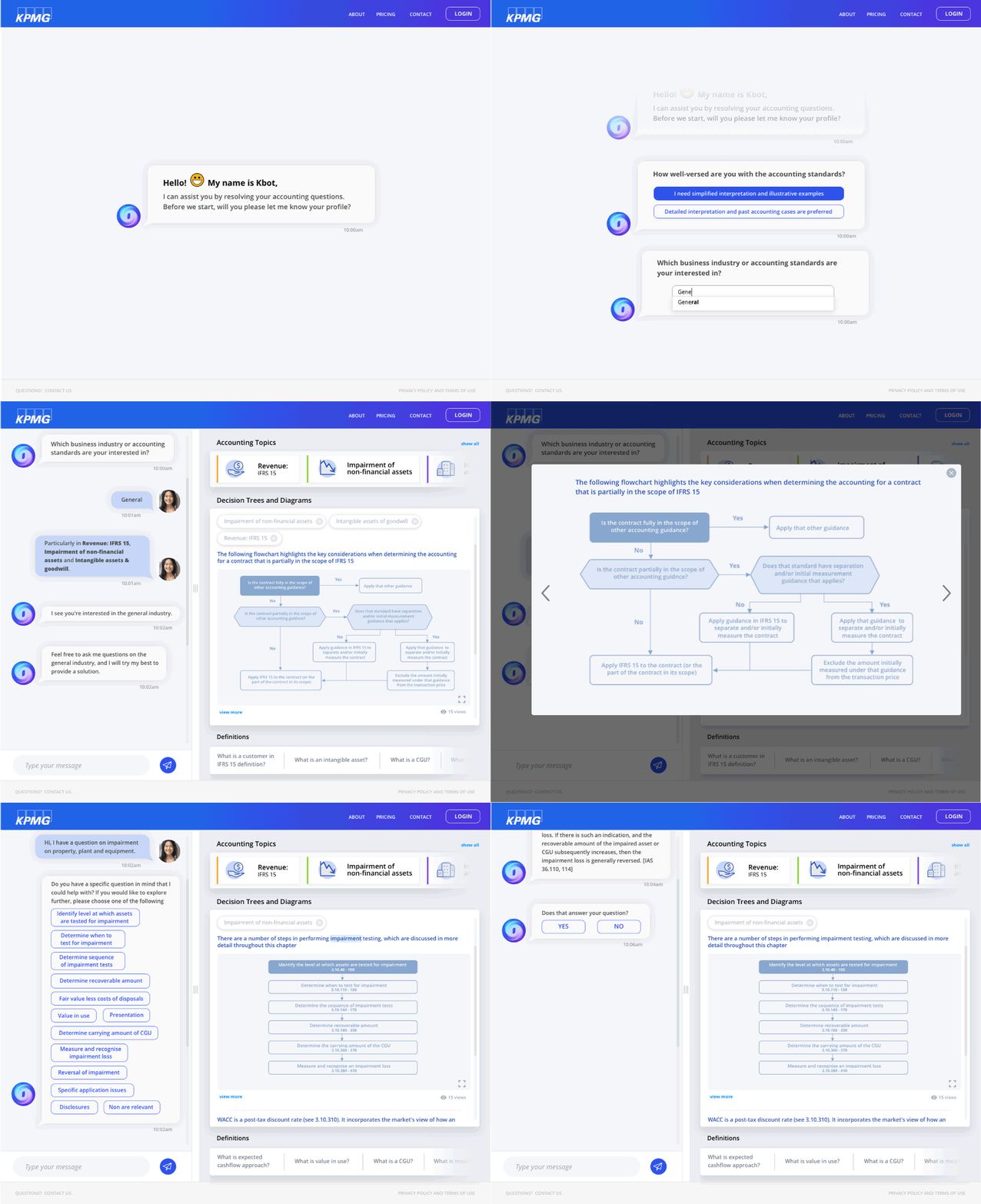
A precision-first research path for quickly locating the relevant standard and its basis.
- Ask an IFRS question in natural language.
- K-Bot interprets the query’s intent and context.
- Receive a source citation and confidence signal.
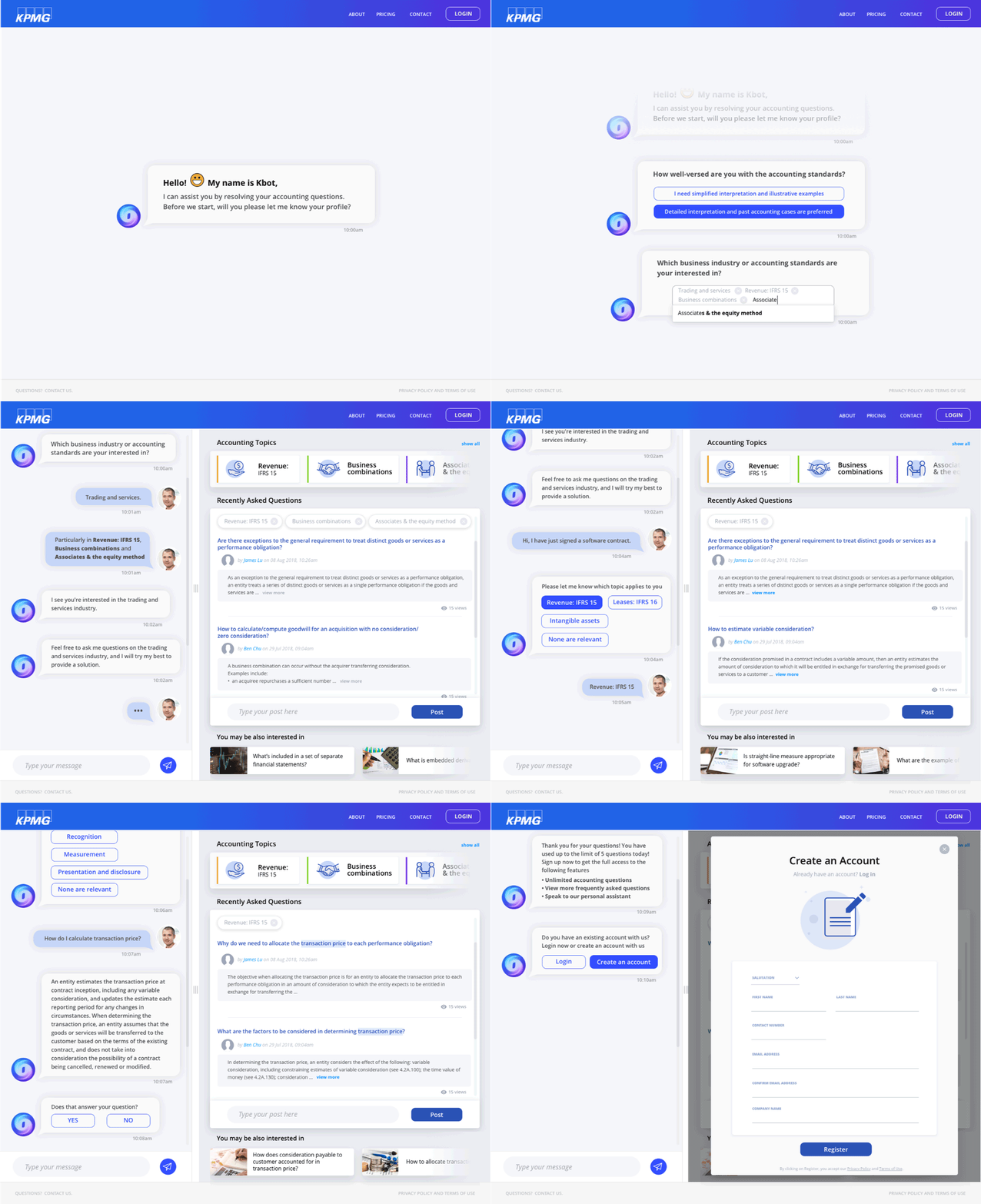
A learning-first path that turns complex standards into clear explanations and practical examples.
- Describe an accounting scenario in plain language.
- K-Bot surfaces a simplified explanation and example.
- See when senior verification is recommended.
Intended impact on audit practice

Trust model: confidence scoring and source citation on every response

High-fidelity prototype: K-Bot interface
The trust model: the problem the design really solved
Unlike the other case studies, K-Bot is already an AI product. But the most important design work wasn't the AI itself. It was the trust layer built around it. Most AI case studies describe what the model does. This one is about what happens when the model is wrong, and how the interface handles that.
Every K-Bot response surfaced a confidence level and a source citation, because research showed auditors rejected answers that sounded certain without evidence. A response flagged “High confidence, Source: IFRS 16.22” was acted on; a bare answer was re-checked manually. The honesty about uncertainty was the feature.
K-Bot was designed with a deliberate ceiling on autonomy. When a response was uncertain or required specialist judgement, it made verification with a senior auditor a first-class outcome. The escalation path preserved the relevant query context, reducing friction while maintaining professional accountability.
The next step would be proactive: given an active audit file, surface the standards likely to matter before the auditor asks, such as IFRS 16 for leases or IFRS 3 for acquisitions. The interaction model was designed with this in mind, though it needs deeper integration with the audit file system.