Employee journey redesign: attrition as a service design problem
People were leaving KPMG, and leadership wanted to fix it. When I dug into the research, I found that the departure decision was being made much earlier than anyone realised, in specific, designable moments during onboarding and performance conversations. Attrition wasn't a people problem. It was a service design problem.
At a glance
Attrition isn't inevitable. It can be addressed from day one.
High attrition at a professional services firm is expensive, visible, and easy to misdiagnose. The instinct is to look at culture, compensation, or workload. What we found in the research was more specific, and more fixable. The decision to leave wasn't forming over months of general dissatisfaction. It was forming in specific, repeatable moments: the first week, when no one had time to help a new joiner; the performance conversation that felt like an evaluation rather than a coaching session; the recognition that never came after a difficult project.
These were service failures. And service failures can be redesigned.
The three critical touchpoints identified across the digital and human employee journey were Onboarding, Engagement and Recognition, and Offboarding. Each represented a moment where the firm's actions either aligned with employee expectations or fell short of them.
Three “How might we” questions that shaped the work
Three career stages, three moments that decide whether people stay
Research was conducted across employee cohorts at different seniority levels and business units. The approach was designed to draw out honest answers in a professional services culture that favours composed, measured responses. We paid as much attention to what was left unsaid as to what was said.

From ad hoc HR processes to a connected journey
Onboarding varies across business units, with no consistent standard for how new joiners are welcomed and oriented.
A consistent onboarding pathway gives new joiners clear orientation, context, and early support.
Managers evaluate rather than coach, with infrequent, backward-looking performance conversations.
Employees own their development, supported by managers who coach with structured conversation guides.
Recognition is informal and inconsistent, dependent on individual managers rather than structured firm-wide mechanisms.
Recognition is structured, visible, and consistent across the firm.
New joiners lack a peer support structure in their first weeks, increasing the risk of early disengagement.
A buddy system connects new joiners with a peer from day one.
Employee experience is treated as a set of discrete HR processes rather than a connected end-to-end journey.
Employee experience is owned as a strategic design problem with ongoing research and iteration.

Employee journey map: current state from joining to departure, with critical touchpoints marked
From research to service design solutions
Designing for moments that build or break belonging
Two primary service design solutions emerged from the research and co-creation process.
The Buddy System addressed the onboarding gap. Being a new employee is both exciting and stressful. While managers play a critical role, a broader team effort is needed to make the first weeks positive and productive. The solution introduced a structured buddy programme, a peer connection designed to provide context, boost early productivity, and improve new-joiner satisfaction through a simple sequence of notifications, calendar invites, shared experiences, and a guided onboarding checklist.
The Performance Management redesign addressed the coaching gap. Employees need more frequent, focused, and future-oriented conversations, and a manager who acts as a coach rather than a boss. The design empowered employees to take ownership of their own development, supported by structured conversation guides that prepared managers to have quality check-ins with their mentees.
A change sustainability framework was developed to address the question that consistently arose during research: Will behaviours and business practices stick, or will people drift back to their old ways? The framework addressed Purpose, Outcomes, Conditions, and Behaviours, the four dimensions that determine whether change endures.
A new joiner and their buddy receive connected prompts that make the first relationship easy to start.
- Buddy is notified that a new joiner has arrived.
- Buddy schedules a calendar invitation to meet.
- New joiner receives and accepts the invitation.
- They meet over complimentary drinks at the clubhouse.
- New joiner completes the guided onboarding checklist.
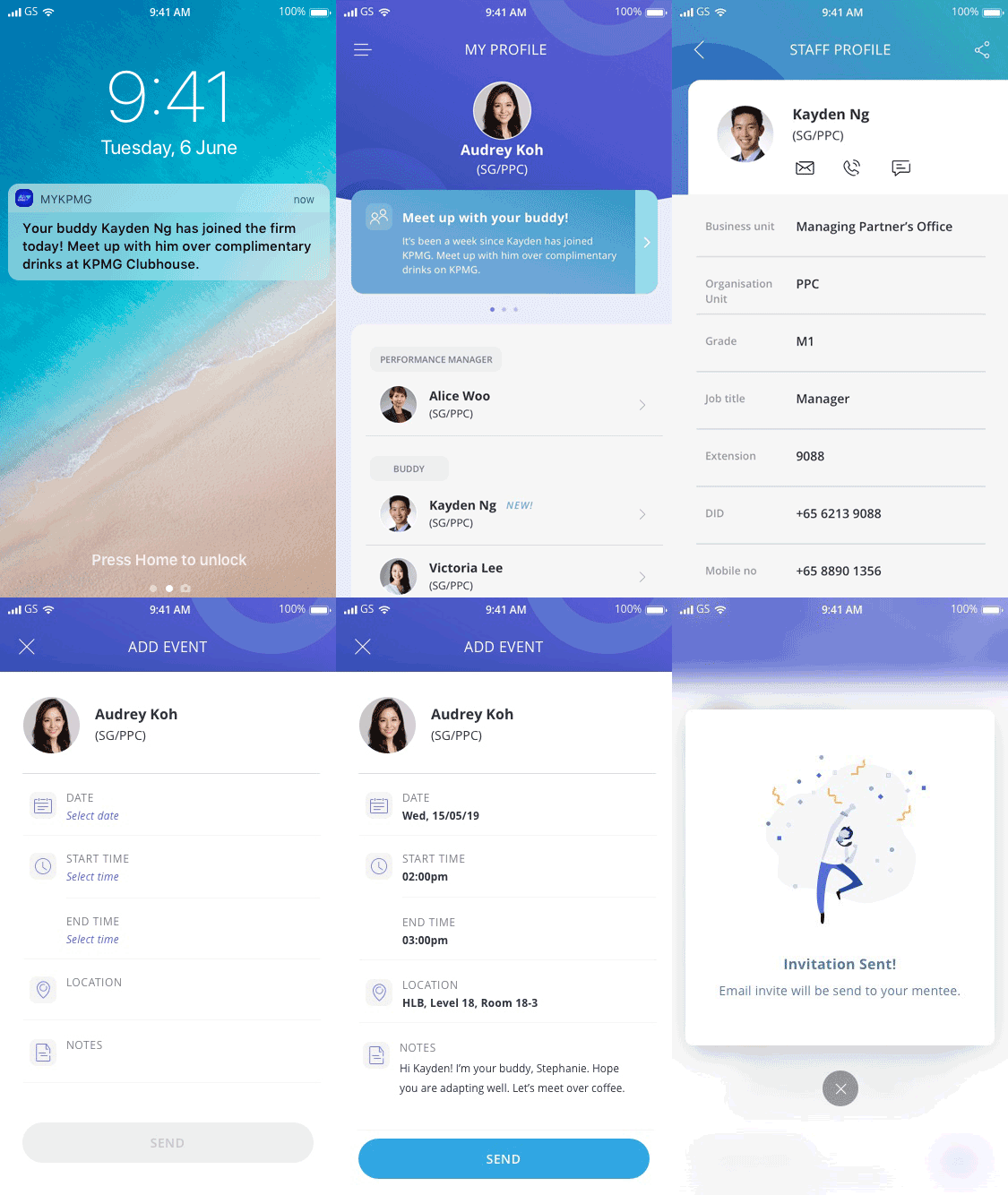
The buddy is prompted to welcome a new joiner.
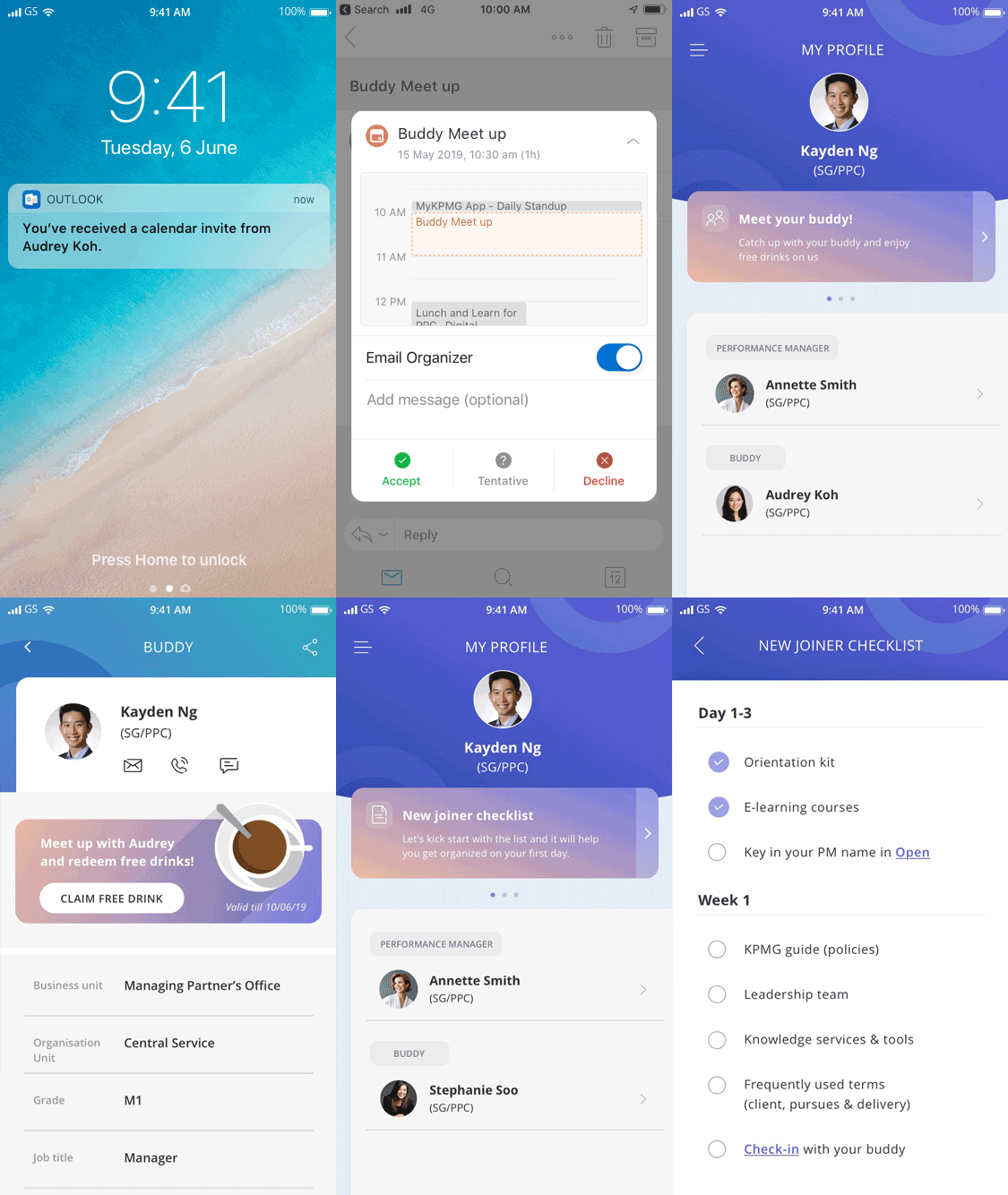
The new joiner receives a practical next step.
Manager prompts and guidance make recurring, future-focused check-ins easier to prepare and sustain.
- Manager receives a timely check-in reminder.
- Manager schedules a check-in with their mentee.
- Manager prepares with the conversation guide.
- Manager leads the check-in using that guide.
- Goals and progress are recorded for follow-up.
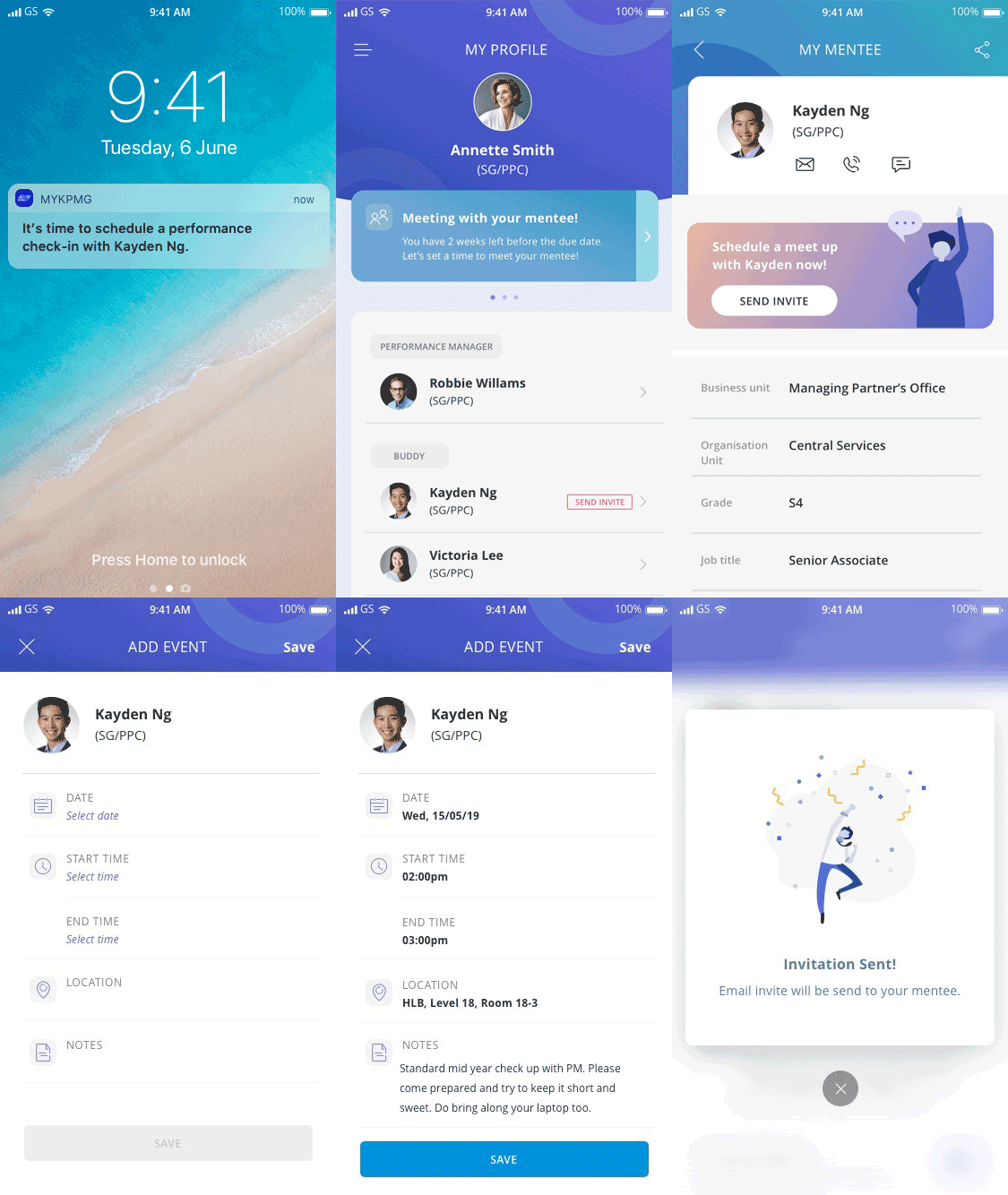
A timely prompt starts a regular performance conversation.
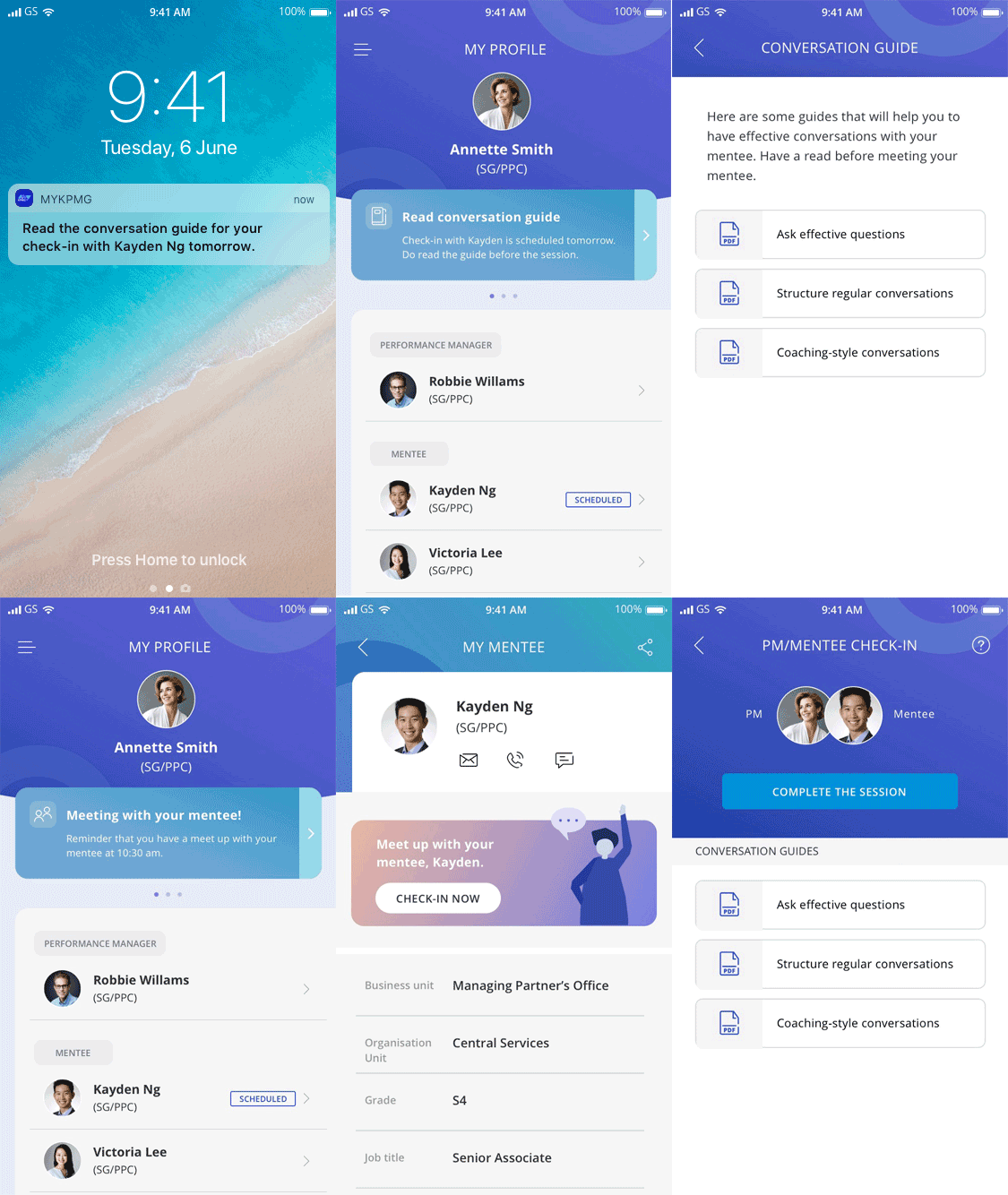
Preparation supports a more focused check-in.

Buddy system flow: new joiner integration within 3 months

Change sustainability framework: buddy, coaching model, recognition
What the work delivered
The project delivered practical, research-grounded solutions to three of KPMG's highest-impact employee experience challenges. The approach reframed attrition as a design problem rather than an HR problem, one that could be addressed through thoughtful, human-centred intervention at the moments that matter most.
Future opportunities, not shipped scope
The KPMG EX project was human-centred, qualitative, organisational service design. But several of its core problems are now solvable with AI in ways that weren't practical in 2018–2020.
Synthesising interviews across new joiners, mid-career professionals, and senior leaders was one of the most time-consuming parts of this project. AI could now speed up theme-finding and highlight where groups disagree about the same touchpoints.
Research showed departure decisions formed early, in onboarding and performance conversations. AI watching signals such as buddy check-ins and conversation scheduling could flag risk sooner, which raises a critical question: who sees this data, and can employees opt out?
Performance conversations felt like evaluations rather than coaching. AI could help managers prepare by surfacing recent work and open follow-ups from the last conversation, lowering the effort that leads them to deprioritise it.